साधना
sadhana · the practiceThe practice, in five parts
What Aastha Saathi does each morning, described exactly — including the part that is not built yet.
पञ्चाङ्ग
panchang · the almanacWhat today actually is.
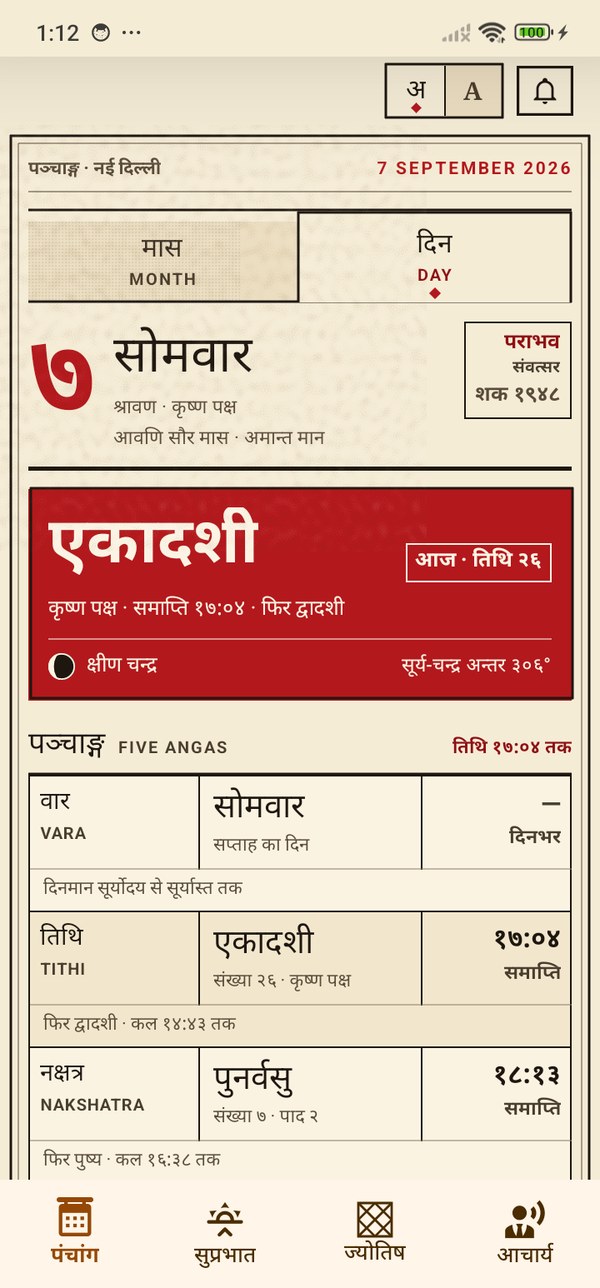
Five limbs — tithi, vara, nakshatra, yoga and karana — and the moment each of them gives way to the next. Aastha Saathi computes them from the positions of the sun and moon for the day you open it, using the drik (observed) method and the Lahiri ayanamsa, with lunar months reckoned amanta. Nothing is looked up in a table typed in years ago; the festivals fall out of the same computation that produces the tithi.
One honest limitation
The almanac is currently computed for a single reference location — New Delhi, Indian Standard Time. Sunrise-dependent values will differ for other cities. Per-city computation is on the backend already; letting you choose your city is not in the app yet.
| तिथिTithi | Lunar day, its paksha, and the clock time it ends — with the one that follows. |
| नक्षत्रNakshatra | The star the moon stands in, its pada, and when the moon leaves it. |
| योगYoga & Karana | Both computed, both with end times, both with their successors named. |
| मुहूर्तMuhurat | Sunrise and sunset, Abhijit muhurat, and the inauspicious spans — Rahu Kalam and Yamagandam. |
| चौघड़ियाChoghadiya | All sixteen slots, eight of the day and eight of the night, tiled without a gap. |
| मासMonth & year | Lunar month with adhika masa marked, solar month, and the samvatsara. |
ज्योतिष
jyotish · the daily readingPrepared for your sky, not for your sign.
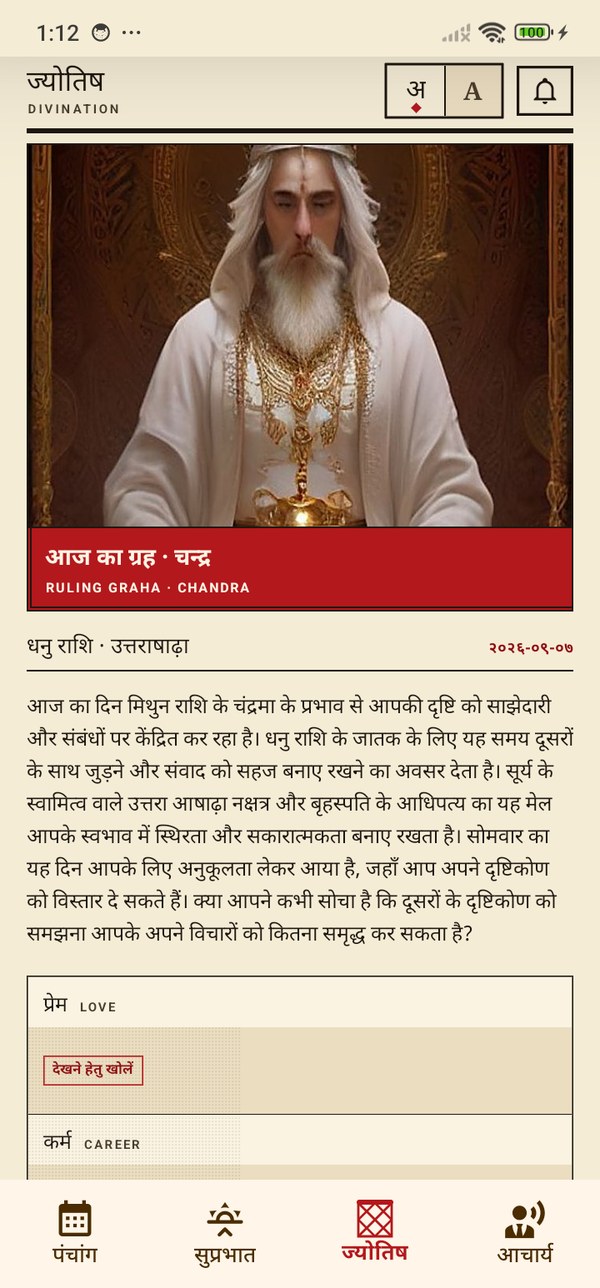
Enter the date, time and place you were born and Aastha Saathi computes your chart: the lagna rising at that moment, your moon rashi and nakshatra, the planets by house and degree, and the mahadasha you are living through. Each morning it draws a reflection from that chart against the day’s own transits.
How it is written matters, so here it is exactly. The chart is calculated from the ephemeris before anything else runs. A language model is then given those computed facts and asked only for prose — it can never supply a position, a rashi or a dasha. If the model is unavailable, you see less; you never see an invented planet. The app marks the reading as AI-written, and frames it, as it should be framed, for reflection rather than prediction.
| लग्नLagna | The ascendant for your exact birth moment and place. |
| राशिRashi | Moon sign and nakshatra — the reading is built on these, not on a sun-sign column. |
| महादशाMahadasha | The Vimshottari period you are in, computed from the moon’s position at birth. |
| कुंडलीKundli | The full chart table: every graha by sign, degree, house and retrogression. |
Where the words come from
Only the reflective prose is model-written, from facts already computed, and the app labels it as such. The model is never permitted to supply a figure.
पुजारी
pujari · the thresholdThe keeper of a temple you chose.
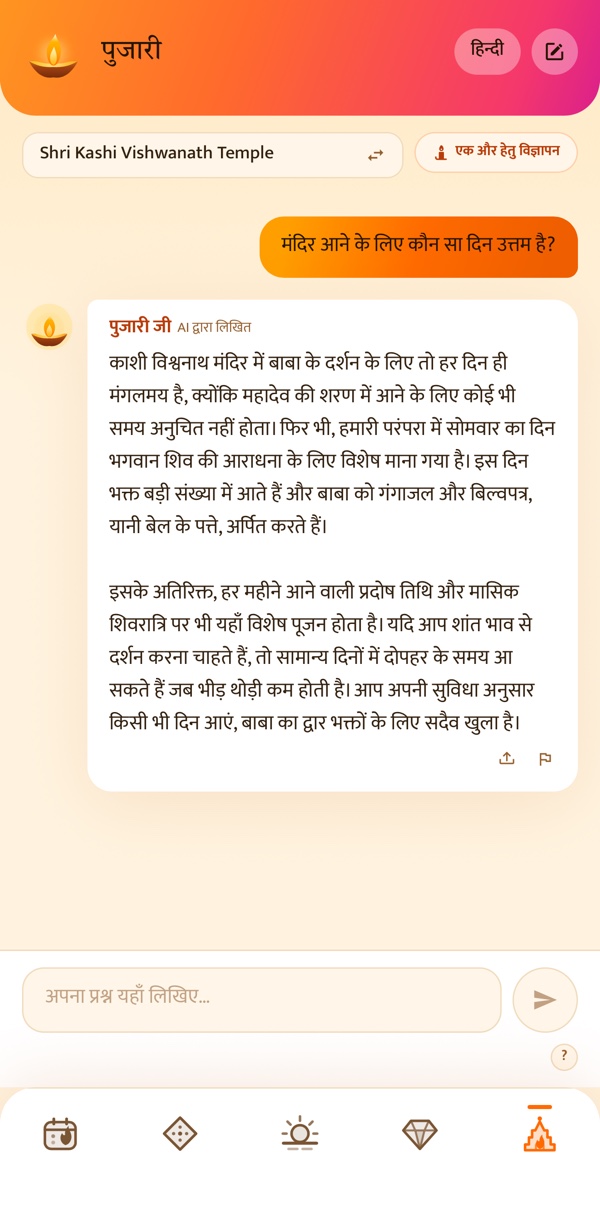
The daily reading is written for you. The threshold is where you ask. You pick a temple from the ones near you, and its pujari is who answers — what to bring when you come, which day the crowd comes, what to say at home on a morning you cannot go, and whatever else is sitting on your mind.
It is a keeper, not an oracle, and it is held to what it has been handed. That is the temple you chose — its name, its presiding deity, its city — and nothing else about the place: it will not invent a founding, a legend or a festival date for a real temple with a real street address, and asked for one it says plainly that it cannot say. If you have entered your birth details it is handed your chart as computed too: your lagna and its lord, every graha by sign, house and degree, the Vimshottari mahadasha and antardasha you are running, and the transits standing over your natal chart this morning. It cannot supply a position, a period or a date of its own — and it does not keep the conversation, which lives on your handset and nowhere else.
What the Pujari is, and is not
An AI, speaking as the keeper of the temple you picked, offered for reflection and cultural interest — the app prints that line under the box you type into. It is not a priest in a lineage, it does not speak for the deity and it never speaks as the deity, and it is not a substitute for medical, legal or financial advice. Asked one of those, it is written to say so plainly and to name the professional you should be asking instead.
| प्रश्नYour question | In your own words — or one of five openings: which day to come, what to offer, a worry at home, the next festival, a prayer to say where you are. |
| मन्दिरYour temple | The one you picked from those near you: its name, its presiding deity and its city. Its history, its stories and its festival dates are not handed over — and are never invented. |
| कुंडलीYour chart | If you have entered your birth details: the same lagna, rashi and graha positions the ज्योतिष tab prints. Computed once, so the two can never disagree. |
| दशाDasha | Mahadasha and antardasha, the years remaining in each, and the period that follows. |
| गोचरTransits | Where the grahas stand today, by house counted from your own natal lagna. |
| भाषाLanguage | Which of the nine you would rather be spoken to in. |
नौ भाषाएँ
nau bhashayen · the nine it answers inThe Pujari answers in these nine. The app around it is set in twelve Indian languages of its own, chosen on the first screen and changeable afterwards — the two are separate on purpose: the language you read an almanac in and the language you would rather be spoken to in are not the same choice.
सुप्रभात
suprabhat · good morningSomething worth sending at dawn.
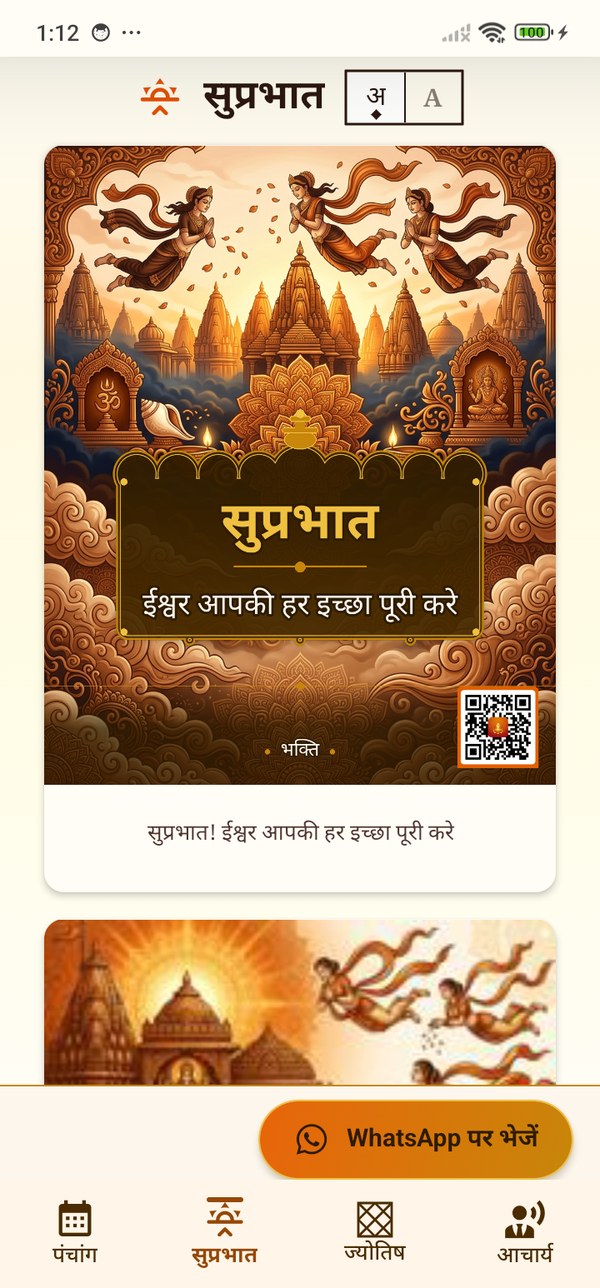
The good-morning image is one of the most-shared things in Indian family life, and most of what circulates is a fifth-generation re-compression of a picture nobody chose. Aastha Saathi makes a fresh set every day — devotional art with a blessing set into it, laid out at full portrait resolution, ready to send to a person or a family group.
| प्रतिदिनFresh daily | A new set is prepared roughly every day; you are not sending yesterday’s picture. |
| साझाMade to share | Full-resolution portrait images, sized for WhatsApp, one tap from the gallery. |
| द्विभाषीBilingual | Blessings in Hindi or English, following the language you have chosen. |
पूजा
puja · worship and observanceKnowing when, and then doing.
Observance begins with timing, and timing is the part Aastha Saathi carries today. The almanac names the auspicious and inauspicious spans of the hours ahead — Abhijit muhurat, Rahu Kalam, the sixteen Choghadiya slots — and the festival days, computed rather than listed, so a vrat or a puja is not kept a day late.
The rite itself is in the app now, and it is the day’s own observance rather than a generic script. Before sunrise it asks for the kolam at the threshold, and keeps the count of mornings you have kept. Then darshan: the deity whose day it is — Guru Dakshinamurthy on a Thursday — with the number of wicks that day takes already lit, and the day’s Nalla Neram and Rahu Kalam set beside him. Then the parayanam: the day’s stotra given one line at a time with its transliteration, advancing as you recite it.
What is still not built is the seva — the service that carries devotion past the shrine. We would rather say that plainly than imply it is coming next week.
| Piece | Standing |
|---|---|
| मुहूर्तMuhurat | Shipping today |
| चौघड़ियाChoghadiya | Shipping today |
| राहु कालRahu Kalam | Shipping today |
| पर्वComputed festival days | Shipping today |
| नित्य कर्मThe daily rite | Shipping today |
| सेवाSeva | Not yet built |
Where this stands
Shipping today: muhurat, Choghadiya, Rahu Kalam, computed festival days, and the daily rite — kolam, darshan and parayanam, set by the day rather than by a generic script. Not yet built: the seva. When it arrives it will be announced here and in the app, not implied in advance.
दर्शन
darshan · a look insideThe app as it actually is.
Four screenshots from the shipping build, four of its five tabs, taken in one sitting on one handset — no mock-ups, no renders of screens we have not made. The fifth is the daily rite, described above.
It costs nothing to begin.
Free on Google Play, in twelve Indian languages, with no account to create.